Your firm’s knowledge.
Your private advantage.
Search your firm’s documents, draft from your templates, and review prior work with private AI deployed on infrastructure you control.

Your experience. Working harder.
Matter search.
Find what you need across your firm’s briefs, pleadings, discovery, and research—with source-linked answers you can verify.
Your documents. A clearer starting point.Your files include prior rulings addressing discovery timing. Review the source documents below.
Drafting from
your templates.
Start from your firm’s voice, precedents, and prior work. Create a first draft with the context your team has already built.
A first draft. Always your review.A first draft, structured around your firm’s template, supported by the documents you select, and ready for your review.
Document review.
Summarize and surface key issues in contracts, discovery, and other firm documents.
Precedent memory.
Keep prior work at your fingertips, so your firm’s experience can inform what comes next.
Built around your firm.
Live in two weeks.
A focused deployment, scoped to your workflows, tools, and security requirements.
- Week 1
Audit & architecture.
Under NDA, we review your environment and agree a written deployment plan.
- Week 2
Deployment & training.
Configure your system, connect your documents, and train your team.
- Ongoing
Maintenance & support.
Updates, model improvements, and help when your team needs it.
Control you can see.
Fully local processing stays on your hardware. Hybrid sends de-identified text to an external model.
Review the security architecture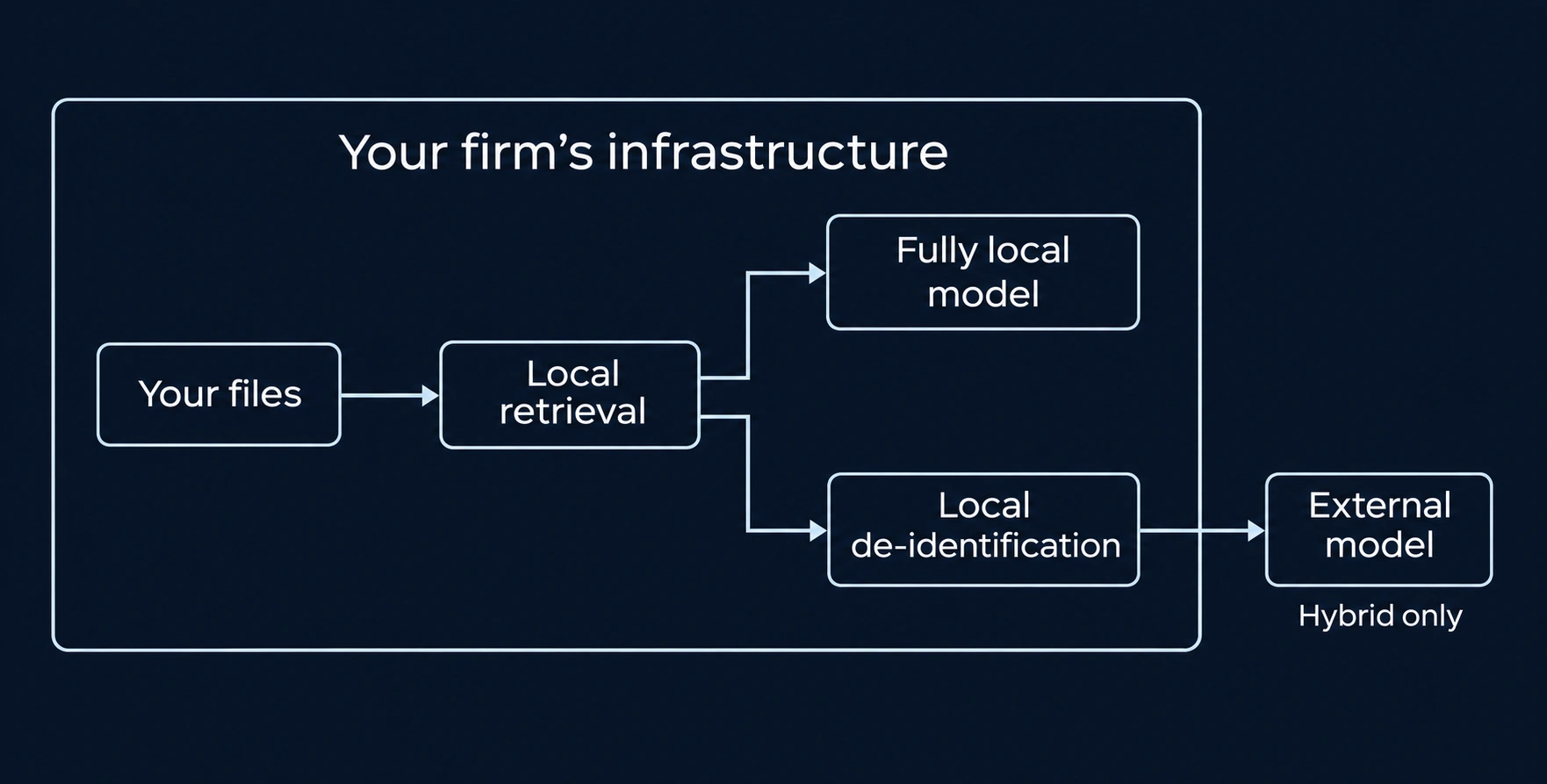
Fully local: Your files → local retrieval → local model. Processing stays on your hardware.
Hybrid: Local retrieval → local de-identification → external model. De-identified text leaves the firm.
What each deployment is designed around
We document your data flows, access arrangements, permissions, logging, and support process before deployment. Fully local and hybrid configurations have different exposure profiles.
De-identification reduces exposure; it does not guarantee that every sensitive detail or re-identification risk is removed. Your firm reviews the configuration and decides which matters are appropriate for each tier.
One firm. One flat fee.
Built into every deployment
- Unlimited seats for your firm
- Both tiers: fully local and hybrid
- Training for your team
- Ongoing maintenance and support
Hardware and any required document-system licensing are purchased separately. Final scope is agreed in your engagement.

Before AI touches
your client files.
Ten questions worth asking every AI vendor.
Questions worth asking.
What hardware do we need?
We assess your existing infrastructure first. If a dedicated workstation or server is needed, we specify it with you. You purchase and own the hardware; it is separate from the deployment fee.
Can it work with our document system?
We review your document management system, network shares, file formats, and access requirements during discovery. Supported integrations and any licensing requirements are confirmed in the written deployment plan.
How do the two tiers differ?
Fully local processing stays on your hardware. The hybrid tier retrieves and de-identifies content locally, then sends de-identified text to an external model for reasoning. De-identification reduces exposure but does not eliminate every re-identification risk. We agree the configuration and appropriate use with your firm.
Do lawyers need to review outputs?
Yes. Lawyers review outputs and verify the cited sources. The system supports research within your firm’s documents and first-draft work; it does not replace professional judgment or provide legal advice.
What does the engagement involve?
An NDA comes first, followed by a fixed-scope engagement and written deployment plan. We agree the scope, access, security configuration, training, and support before deployment begins.

A private advantage.
A practical next step.
Start with a conversation, before sharing any client files.